
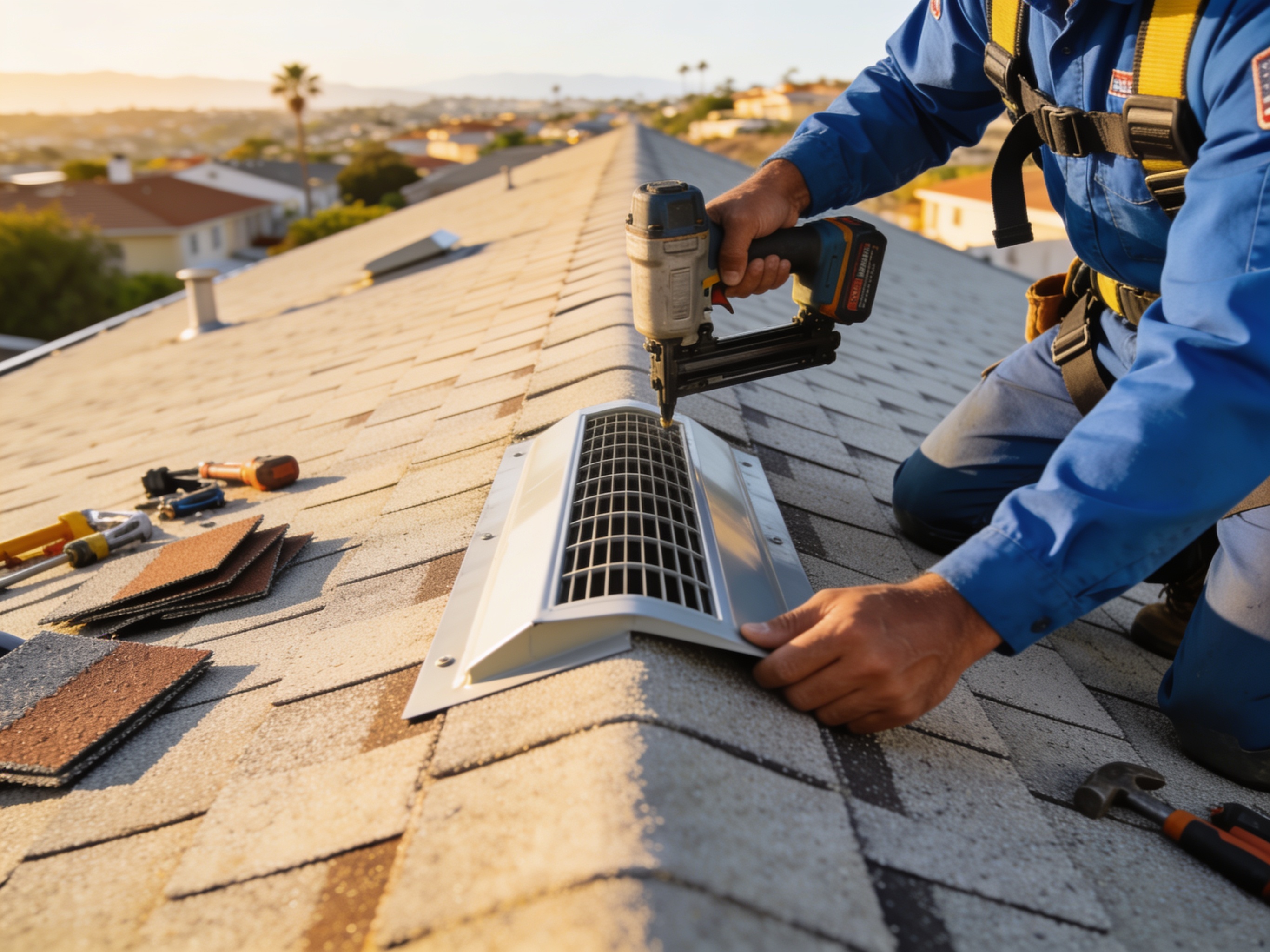
San Diego homes in neighborhoods like North Park and Mission Valley often feature older composition or clay tile roofs that trap heat when ridge ventilation is missing or undersized. A correctly sized ridge vent pulls hot air out the peak while intake vents at the eaves bring cooler air in, reducing attic temperatures that can otherwise shorten shingle life or damage insulation. In our Mediterranean climate, even moderate summer heat combined with occasional marine layers makes balanced ventilation essential rather than optional.
Tile roofs common in La Jolla and Coronado require vent profiles that match the existing tile without creating leak points at the ridge. We cut the sheathing back precisely, install a rigid vent base, and seal every joint with high-temperature flashing compatible with salt air exposure. California building code requires net free ventilation area based on attic square footage; skipping the calculation or using undersized vents is the most frequent reason we are called back to homes in Downtown San Diego and Pacific Beach.
Improper ridge vent work frequently shows up as water intrusion during the first winter rains because the vent was not integrated with the existing underlayment or step flashing. We always verify the ridge board condition first; many 1960s–1980s homes in La Mesa and Chula Vista have sagging ridges that must be sistered before any vent can be installed. Using the wrong nail pattern or skipping butyl tape under the vent flange creates the exact leak paths homeowners later blame on the product itself.
Technician insight
In San Diego the thing that catches most people out with ridge vent installation is the combination of older ridge boards and salt air. Homes in North Park and Mission Valley from the 1970s often have sagging ridges that must be sistered first, and using standard galvanized flashing instead of marine-grade material leads to corrosion streaks within a couple of seasons.
North Park Tile Roof Ridge Vent
Homeowner noticed attic temperatures staying high even on mild days. We found the original ridge had no venting and the ridge board had minor sag. After sistering the ridge and installing profile-matched tile vents with proper underlayment integration, the attic now breathes correctly and the roof remains leak-free through winter rains.
Ridge Vent Installation Services We Offer
✓Asphalt Shingle Ridge Vent Installation
Matches existing shingles with low-profile vent sections that maintain roof aesthetics while providing continuous ridge ventilation on standard San Diego homes.
✓Clay Tile Ridge Vent Installation
Uses profile-matched vent tiles and under-ridge venting to preserve the look of tile roofs common in La Jolla and Coronado without cutting corners on sealing.
✓Ridge Vent Replacement on Older Roofs
Removes failed or undersized ridge vents on 1970s–1990s homes in North Park and Mission Valley and installs code-compliant venting sized to attic square footage.
✓Metal Roof Ridge Vent Retrofit
Adds ridge venting to standing-seam or corrugated metal roofs found on some Pacific Beach and Downtown properties while maintaining weather-tight seams.
✓High-Wind Ridge Vent Installation
Uses reinforced vent sections rated for coastal gusts to handle San Diego's occasional Santa Ana wind events without dislodging or leaking.
Ridge Vent Installation Cost in San Diego, CA
| Service | Typical Range | What Affects It |
|---|---|---|
| Standard Asphalt Ridge Vent (up to 40 linear feet) | $950–$1,600 | Price rises with steep pitch or second-story access |
| Clay Tile Ridge Vent Installation | $1,400–$2,400 | Includes profile-matched vent tiles and extra sealing labor |
| Ridge Board Repair Before Vent Install | $350–$750 | Common on 1970s–1980s homes in North Park and La Mesa |
| High-Wind Coastal Vent Upgrade | $200–$450 | Added cost for reinforced sections near Pacific Beach or La Jolla Cove |
Ranges are typical for San Diego, CA and confirmed with an exact written quote before any work starts.
How it works
- 1
Attic and Roof Inspection
We measure attic square footage, check existing intake vents, and inspect the ridge board condition from both inside and out.
- 2
Ridge Preparation
Old capping or damaged ridge material is removed, sheathing is cut back to the required opening width, and any sagging framing is reinforced.
- 3
Vent Base and Flashing
The vent base is fastened with the correct nail schedule, butyl tape is applied at all seams, and step flashing is woven into the existing roof layers.
- 4
Final Integration and Testing
Cap shingles or tiles are reinstalled to match the roof, all penetrations are sealed, and attic airflow is verified before leaving the site.
Pricing
Most ridge vent jobs in San Diego fall between $900 and $2,800 depending on roof length, material, and whether framing repairs are needed.