
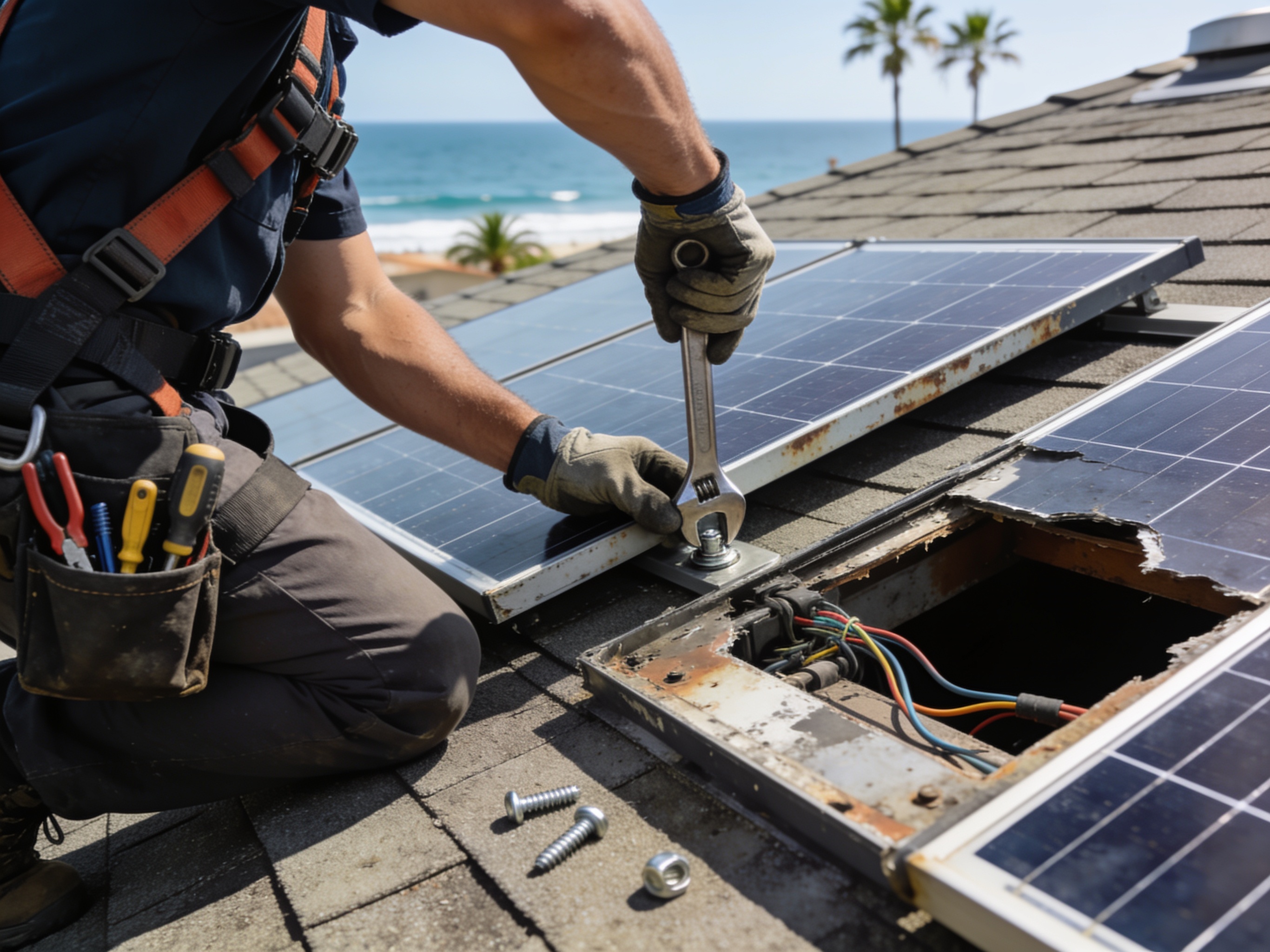
San Diego’s mild coastal Mediterranean climate keeps roofs in service longer than inland counties, yet the constant salt air near La Jolla Cove and Pacific Beach accelerates corrosion of aluminum flashing and butyl seals under solar mounts. Older homes in North Park and Mission Valley often carry 1960s–1980s concrete tile or built-up roofs that were never engineered for the point loads and penetrations added later for panels. When water tracks along lag bolts into the sheathing, the damage spreads under the array where visual inspection is impossible until interior staining appears.
San Diego County building rules require any work that disturbs more than 10 percent of a roof plane to meet current Title 24 waterproofing standards, so technicians must pull permits and replace underlayment to match existing material rather than simply caulking over old penetrations. On flat roofs common in commercial conversions around Downtown San Diego, ponding water around ballasted arrays demands tapered insulation and liquid-applied membrane patches instead of traditional shingles. Homeowners in Coronado and Chula Vista frequently discover that panel removal is required before any warranty claim on the original roof can proceed.
Edge cases include mismatched tile profiles after reinstallation that create new wind-driven rain entry points and conduit runs that were never flashed properly on steep La Jolla slopes. Technicians carry spare S-tiles and custom lead boots sized for the exact rack hardware installed in the 2010s, because generic flashings fail within two seasons here. Work is scheduled around the dry months to avoid rain delays, yet crews still stage tarps and temporary ridge vents to keep attics dry during multi-day array removals.
Technician insight
In San Diego, the thing that catches most people out with Solar Panel Roof Repair is how the constant salt air along the coast from Pacific Beach to Coronado eats through the original butyl seals in five to seven years on the 1980s tile roofs common in La Jolla, while the mild climate keeps the rest of the roof looking fine until water reaches the attic.
North Park Tile Roof Leak Under Panels
Homeowner noticed ceiling stains after a rare winter rain. Inspection showed water tracking along three lag bolts on a 1987 concrete tile roof. Crew removed the six affected panels, replaced the underlayment and lead boots, then reset the array with new stainless hardware. No further moisture appeared after the next rain cycle.
Solar Panel Roof Repair Services We Offer
✓Solar Mount Leak Repairs
Remove panels, replace corroded flashing and butyl, then reinstall with new butyl tape and stainless hardware to stop active leaks.
✓Solar Panel Removal and Reinstallation
Take down arrays for roof access, store panels safely, perform repairs, then reset to original torque specs and wiring layout.
✓Tile Roof Solar Panel Adjustments
Lift and realign S-tile or barrel tile under racks on older North Park and La Jolla homes to eliminate wind-driven rain gaps.
✓Flat Roof Solar Array Waterproofing
Apply reinforced liquid membrane and new tapered crickets around ballasted systems on Downtown and Mission Valley buildings.
✓Conduit and Penetration Sealing
Replace failed roof boots and flashings around wiring entries that were installed without proper underlayment integration.
Solar Panel Roof Repair Cost in San Diego, CA
| Service | Typical Range | What Affects It |
|---|---|---|
| Solar Mount Leak Repair (single area) | $650–$1,100 | Higher on steep tile roofs in La Jolla |
| Full Array Removal and Reinstall | $1,400–$2,800 | Depends on panel count and wiring complexity |
| Flat Roof Membrane Patch Under Array | $900–$1,600 | Includes tapered insulation where ponding exists |
| Conduit Penetration Resealing | $350–$650 | Per penetration on older built-up roofs |
Ranges are typical for San Diego, CA and confirmed with an exact written quote before any work starts.
How it works
- 1
On-Site Assessment
Inspect array from attic and roof, document active leaks, note roof age and material in neighborhoods like Pacific Beach or Coronado.
- 2
Panel Removal
Disconnect and label wiring, lift panels onto padded racks, protect adjacent tiles or membrane during lift.
- 3
Roof Repair
Replace damaged underlayment and flashing, apply new sealants rated for coastal exposure, match existing tile or membrane.
- 4
Reinstallation and Test
Reset panels, torque to manufacturer specs, run water test, confirm no new attic moisture with moisture meter.
Pricing
Upfront written quote after roof inspection; price varies by number of panels, roof access, and material type.